Category: Uncategorized

  • The Man in Your Walls Has Feelings Too

    The Man in Your Walls Has Feelings Too

    There is a man in your walls. He listens to everything you do. He follows you around, even if you leave your house. If you started feeling that way, you would probably consult a psychiatrist or psychologist. But what if they told you that you are actually not paranoid, but that chances are quite likely that there indeed is someone watching your every step? This realisation adequately describes the state of mind that people in the GDR used to live with. But who are these people watching your every step, and how does it affect those who spend their entire day in the lives of others? Das Leben der Anderen asks exactly that question and reminds us of the redeeming power of art in the face of oppression.

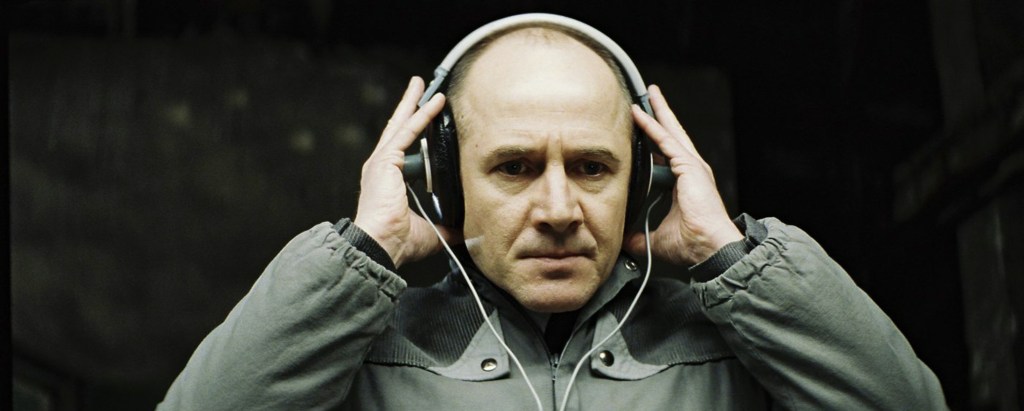
    Das Leben der Anderen follows Gerd Wiesler, who is a dedicated Stasi agent in Berlin in 1984. Tasked with monitoring the seemingly regime-loyal playwright Georg Dreyman, as well as his lover Christa-Maria Siedland, he starts to sympathise with the couple and questions the morality of his own choices. Dryman becomes disillusioned after his blacklisted mentor kills himself and secretly writes an article about high suicide rates in the GDR. This starts a game of cat and mouse. The Stasi employs more and more agents to persecute Dryman, whilst Wiesler, moved by Dryman’s humanity and passion, subtly starts to manipulate the investigation. 

    Directed by Florian Henckel von Donnersmarck, Das Leben der Anderen employs a slow, restrained and observational style that reflects Wiesler’s role as a silent observer.  Shots are static and often shot in close-ups or mediums, giving the movie a feeling of claustrophobia within the movie’s confined spaces. Tension builds steadily, as the slow pace of the editing emulates the meticulous nature of surveillance. It also commands the attention of the viewer, as shot transitions seem more important the less they are used. The film builds a strong visual parallel between Dreyman’s life and Wiesler’s reaction to it, almost simulating it upstairs. 

    Von Donnersmarck explores notions of paranoia, control and loss of privacy. The perceived omnipresence of the state is felt in every action characters undertake, every thought and conversation, and every instance of private life can lead to persecution. The state’s power is constructed through surveillance, infringing on the autonomy of the individual. And we, as viewers, are complicit in this surveillance. 

    Just like Wiesler, we spy on Dreyman and his lover, follow their every move, and start to sympathise with his struggles. The movie reminds us of the redeeming power of art, as the exposure to love, passion and resistance against impossible odds inspires Wiesler to question his actions. Wiesler’s redemption becomes our redemption. We are reminded that our passion for movies is more than just the act of voyeurism. Art becomes a form of resistance to the dehumanising force of oppression, a call to action, a reminder that our actions hold meaning. 

    I may not have lived during the GDR, nor do I come from the eastern parts of Germany, but still, I relate to the dullness that Dreyman is resisting. It addresses something that has pressed me since I was a kid, the philistine conformity of everyday life. It definitely inspired me to be a better person and to stand for my beliefs.

    When Wiesler, through the hidden microphones in Dreyman’s walls, listens to Beethoven’s Sonata for a Good Man, it marks his recognition of guilt and his road to reconciliation. Through Dryman’s life, he had realised his agency. It reminds us, as cinephiles, that we must find our own agency too, we who spend so much time in the lives of others.  
  • The Beauty Of a 9 To 5

    The Beauty Of a 9 To 5

    You don’t need to create to be an artist. There are enough art forms, like process art or performance art, that allow you to creatively express yourself without having to be a painter or sculptor in the classical sense. But what about the art of living? How can we find a sense of beauty, expression, meaning or a sense of self in the mundanity of modern-day life, with a 9 to 5 job, that is the same every day?  Perfect Days by Wim Wenders manages to show us how. It’s a meditation on beauty and simplicity. A reminder of the importance of taking a break and paying attention to the small things around us. It rejects grand narratives and sensational excitement. Polite and understated, Perfect Days is as calming as it is instructive. 

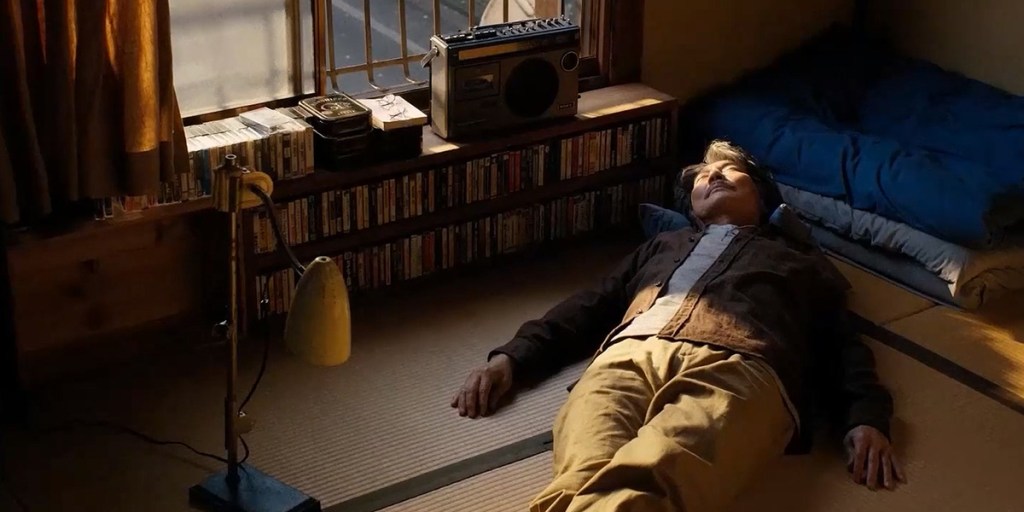
    Hirayama is 60 years old, lives in a small apartment and cleans toilets for a living. He wakes up every morning before the sun comes up, tends his plants, drinks coffee from a vending machine and then drives to work. He cleans toilets for the whole day, drives homes, reads and then goes to sleep. This repeats for every day. While this might sound depressing it is deeply relaxing to watch. 

    As we follow Hirayama on every step, his methodological routine builds a narrative rhythm that functions with minimal dialogue. Conversations are sparse, and communicate more with what remains unsaid. This episodic rhythm gets occasionally disrupted, whether it is his niece suddenly appearing in front of his door, smaller interactions with his coworker, or brief hints about his past. These interruptions offer us an idea of the deeper emotional undercurrent, that is, Hirayama’s inner life. Although he never voices his thoughts and feelings, we can catch a glimpse of his inner world when he listens to classic rock on old cassette tapes. 

    Hirayama’s unhurried attitude on life is also reflected in the film’s visual language. Wenders employs slow, static shots that allow us to immerse ourselves in Hirayama’s world. The shot composition is always precisely balanced, often playing with contrasts or symmetry, adding to the calming presence that this movie radiates. 

    The film’s setting is essential here. Wenders’ love for Tokyo shines through every scene. The city does not come across as a loud metropolis shrouded in anonymity and distress, but rather as a place of calming rhythms. Especially as we spent most of our time in the more intimate sides of Tokyo. Speaking of which, it is important to mention here that the public toilets are beautifully designed and stand out architecturally within the parks and squares of the city. None of the scenes are shot in a studio; everything is filmed on location, and we spend most of our time outside. The film emphasises natural light, and the soft glow of Tokyo at dusk and dawn is a beautiful sight to see. 

    This beauty does not go unnoticed. Hirayama embraces small moments, like light shining through the trees, and captures the ephemeral beauty with his point and shoot camera. Wenders makes sure to highlight these small everyday actions, like cautiously folding a towel, attentively watering a plant or diligently cleaning a mirror. Hirayama’s careful nature elevates even the smallest actions into meaningful gestures.

    Perfect Days is my personal reminder to embrace the small, everyday moments in life. That there is freedom in simplicity and that fulfilment does not need to come from big achievements. Perfect Days is a life-affirming masterpiece that brings a content acceptance to the fleeting nature of life. It shows us how to master the art of life. How to resist distractions and indifference. It encourages us to be artists, it encourages us to live artistically.  

  • Normality No More

    Normality No More

    “And though fish are not animals, they do have feelings”. If something as dull as this made you chuckle, this album is for you. It certainly worked for me. Headache is one of these weird projects that appear out of nowhere, release one album, and then disappear again. Without anything comparable to it, you are left hopelessly wanting for more. 

    Headache is a project produced by Vegyn, who has also worked for Frank Ocean and Travis Scott, which combines text-to-speech AI voices with dreamy synths and ambient trip-hop beats. This mixture doesn’t only sound weird, it intentionally is. While performed by AI, the lyrics are actually handwritten by Francis Hornsby Clark, an author shrouded in mystery. This uncanny clash of human emotion with artificial expression becomes the guiding theme for the debut album The Head Hurts but the Heart Knows the Truth.

    While the text-to-speech voice sounds like its straight out of an 2014 mlg meme shitpost, the character of headache expresses feelings of loneliness, alienation and existential dread. “It’s the drivel of a constant monologue of somebody that’s so self-obsessed but can’t stop themselves”, Vegyn explains himself in an interview with Crack magazine and further characterises Headache as “this white, upper-middle class, almost aristocratic English dude with a real chip on his shoulder and very little self-awareness”.

    This might be setup rather humorous, and large portions of the lyrics clearly are meant as a joke yet, the themes of estrangement, longing, and existentialism still come from a place of sincerity. Partly relatable, partly absurd, the project is defined by contrasts, like the AI voice clashing with the sad tinge of the musical background. A constant, uncanny feeling that accompanies you when listening to the album, just to be interrupted by silly phrases like “I don’t talk English, I talk Toyota”. 

    Sonically, this album serves a sweet nostalgia that is akin to the ambient electronica of the 90s. Reminiscent of artists such as Boards of Canada or Massive Attack, Vegyn produces a masterclass of ambient trip-hop fusion. Floaty synths playfully develop around looped drums. While being able to capture an acute feeling of nostalgia, it yet somehow remains contemporary. Vegyn’s own modern touch is still very clear and present. Bridging both worlds into a novel sonic terrain is one of the strong points of this record. 

    Tracks like “Truisms 4 Dummies” and “Bucket Listener” create deeply emotional backdrops for the dull artificial voice to talk over. While the former propels the listener with a sense of carefree optimism with its upbeat synths and warm pads, the latter unfolds a sincere feeling of longing, regret and melancholic sentimentality. While these strong emotional evocations stand in diametrical contrast to the monotonous text-to-speech voice, they manage to humanise its artificial companion. It is an effective synergy that drives themes of introspection, identity and the human condition while simultaneously not taking itself too seriously. 

    Headache manages to exist within the in-between. A liminal, transitory space, between sarcasm and total sincerity, between artificial production and deeply human experientiality. The savvy mixture of feeling like you are completely on your own in life and the realisation “hey, I can still dance”. 

    The Head hurts but the Heart Knows the Truth points at the absurd. It reflects on the dull, monotonous, yet anxiety-ridden experiences of the everyday and how easily any sense of normality can be left behind. Listening to this album, you either start crying and have an existential crisis or laugh at the dumb jokes and superficial statements made. Maybe even both. Whatever your experience, this album does not belittle you for it. It embraces its own strange setup in a cathartic release of expression. Where things are allowed to be dumb and silly, while still carrying deep emotional baggage. 

    It is my personal reminder that not everything needs to make sense in life, that it is normal to feel like you are not. It encourages you to embrace the small absurdities of life whenever you can. Even if you feel like there is nothing to do, you can still dance.